
Breaking the Spell
How to Shift Out of ADHD Hyperfocus


You’re deep in it. Maybe it’s a creative project, a rabbit hole of research, or alphabetising your spice rack. Hours have passed. The texts have piled up. Your bladder is crying. You were supposed to leave half an hour ago. But your brain? It’s locked in.
Welcome to the magnetic pull of ADHD hyperfocus; equal parts superpower and trapdoor.
In this article, we’ll unpack why it’s so hard for ADHD brains to shift focus once locked in, the neurobiology behind perseveration (the brain’s tendency to get stuck on a thought, task, or action and struggle to shift away, even when it’s no longer helpful, and how to gently break the spell without crashing your nervous system or losing your momentum.
What Is Hyperfocus
Hyperfocus is a state of intense, prolonged attention, often experienced by people with ADHD when something is stimulating, novel, emotionally relevant, or dopamine-rewarding.
Unlike typical attention, hyperfocus doesn’t involve active control. You don’t choose it, it chooses you. It’s not exactly disciplined; it’s that the task has hijacked your dopamine system.
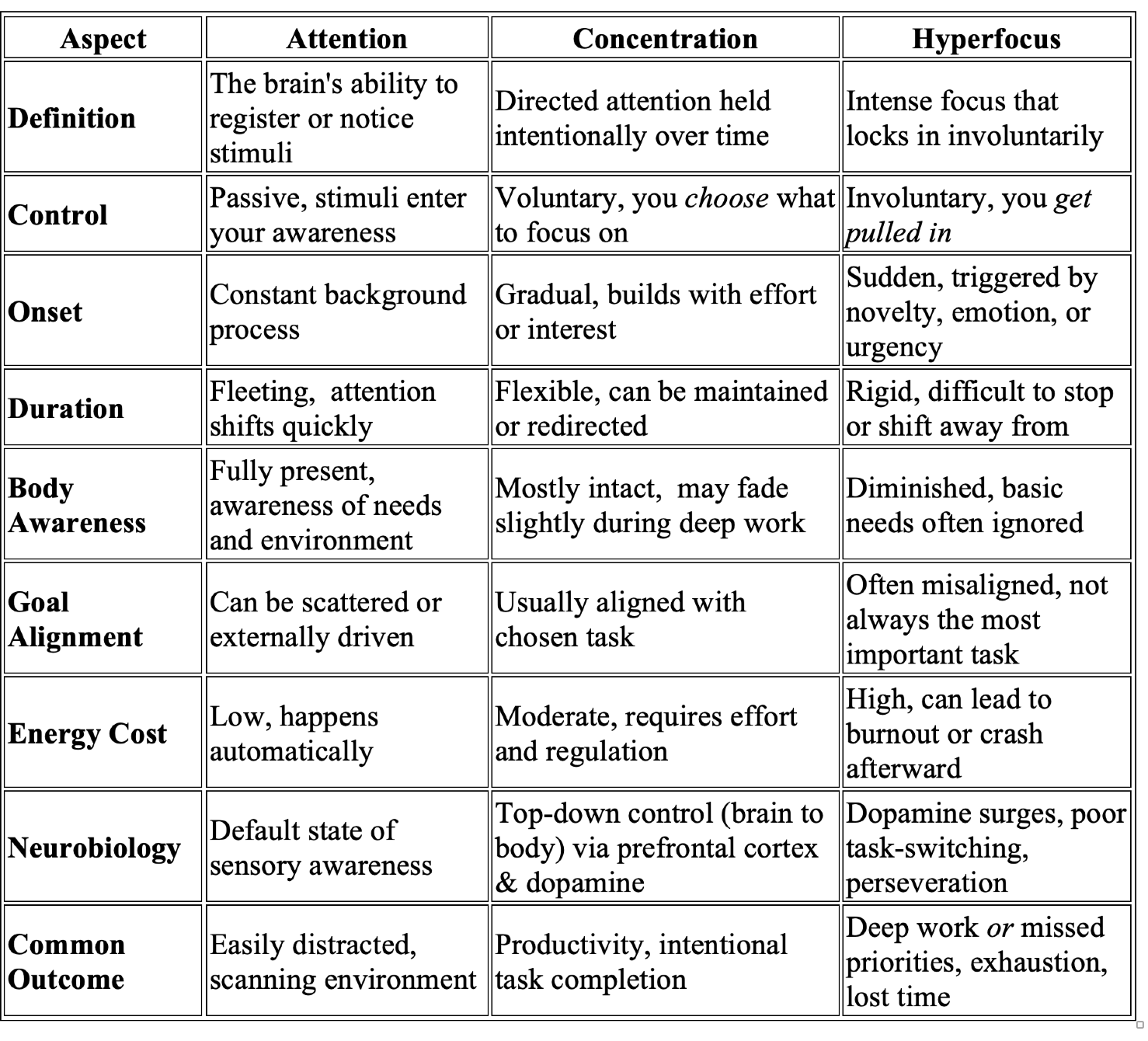
Many people use attention, concentration, and hyperfocus interchangeably, but they’re actually very different states. Attention is your brain’s ability to notice or register stimuli, it’s the open radar. Concentration is what happens when you direct that attention deliberately, holding focus on one thing by choice. But hyperfocus is something else entirely: it’s when the ADHD brain locks in automatically, often without warning, and can’t easily disengage. It’s not effortful like concentration, it’s immersive, sometimes obsessive, and biologically driven by dopamine surges and reduced task-switching flexibility. Where concentration is flexible and intentional, hyperfocus is sticky and compulsive, brilliant in some moments, disruptive in others.
For many ADHDers, hyperfocus can feel like:
A beautiful, energised flow state
A blackout zone where time and body signals vanish
A way to bypass executive dysfunction (he brain’s self-management system, helping us plan, focus, switch tasks, regulate emotions, and follow through) — until it backfires)
Hyperfocus isn’t officially listed as a diagnostic criterion, but it’s well-documented in the lived experience of ADHD and closely linked to the brain’s unique relationship with reward pathways and cognitive flexibility.
Summary Table: Differences Attention, Concentration,Hyperfocus
The Neurobiology of Perseveration
Let’s talk about why shifting gears is so difficult.
ADHD is associated with impaired executive function, particularly in the areas of task switching, working memory, and response inhibition. In simple terms: once we’re in a groove, we lack the internal brake or flexibility to stop and pivot.
Here’s what’s happening under the hood:
Low dopamine tone; in the prefrontal cortex means ADHD brains are constantly seeking stimulation. Once they find it, they don’t want to let it go.
Perseveration; the brain’s tendency to fixate, repeat, or continue a task or thought beyond its usefulness is common in ADHD, especially under stress or overstimulation.
Transitioning; moving on to a new task can feel like a mini withdrawal, your brain resists leaving what feels good, even when it’s no longer productive.
Think of it like this: the ADHD brain isn’t stuck because it’s lazy. It’s stuck because the neurological clutch is jammed.
Fear of Losing Hyperfocus
Many of my clients express a deep fear about starting ADHD medication—not because they don’t want support, but because they worry it will dull their creativity or take away the spark of hyperfocus that has often been their secret source of brilliance. For some, it feels like trading magic for management.
What ADHD meds actually do:
Stimulant medications (like methylphenidate or amphetamines) don’t “remove” hyperfocus, they support dopamine regulation and help the brain access focus more intentionally, rather than only when the nervous system is hijacked by urgency or novelty.
Instead of dampening your creativity or passion, a well-suited medication often helps you shift focus more easily, start without dread, and stop without emotional crash.
Why it can feel like you’ve lost your magic:
If you're used to chaotic, adrenaline-fuelled hyperfocus as your main access point to productivity, regulated attention can feel boring. Flat. Less intense. You might miss the thrill, even if it was burning you out.
That’s not loss of talent, it’s a recalibration.
What helps:
Start slow: Low doses help you observe subtle shifts before jumping to conclusions.
Track what’s changing: Is your creativity truly gone, or are you adjusting to a new gear?
Name the grief: For some, hyperfocus was a survival strategy. Letting go of that can bring up loss, even if the new path is gentler.
Supplement with rituals: You can still access deep focus through structure, environment, and emotional engagement, without relying on chaos.
Medication doesn't have to erase your superpowers. When right-sized, it helps you use them without collapsing afterwards.
The Hidden Cost of Staying in Hyperfocus
While hyperfocus can be productive, especially for creative or complex tasks, it can also:
Lead to physical neglect (eating, drinking, toileting, resting)
Cause missed deadlines or neglected priorities
Burn out your dopamine system, leaving you dysregulated or crashed afterward
So yes, it’s a gift. But it needs scaffolding.
How to Shift Out Without Breaking Yourself
1. Cue the Exit Early
Set up exit cues before you enter hyperfocus. This might include:
Timers with gentle tones (or vibrating alerts)
Music playlists that end at a specific time
A friend or partner checking in to pull you out
This isn’t about control, it’s about creating external brakes your brain can respond to.
2. Close the Loop Visually
ADHD brains don’t like leaving things open-ended. It feels unsafe. So create a “pause point”:
Write a note about where you’re leaving off
Set up the task so it’s easy to return to
Screenshot or voice note your current idea
You’re not stopping forever—you’re just pressing save.
3. Bring in the Body
Hyperfocus lives in the mind. The body grounds us in the now.
Stand up and stretch
Splash cold water on your face
Do a few rounds of box breathing (inhale 4, hold 4, exhale 4, hold 4)
This signals to your nervous system: We’re shifting now.
4. Name the Resistance
Try this internal dialogue:
“Part of me wants to keep going. And part of me knows something else needs my attention.”
When you validate both parts, you reduce internal conflict and you’re more likely to transition without a shutdown.
5. Reward the Pivot
Shifting tasks means losing dopamine. So give yourself a little hit:
Promise a reward after the next task
Pair the new task with something pleasant (music, drink, sunshine)
Celebrate the pivot itself
Your brain needs to know that transitions are safe and rewarding, not punishing.
Hyperfocus isn’t bad. It’s part of how your brain works. It’s the “juice,” the tunnel, the place where ideas click and clarity lands.
But being able to exit that state without falling apart? That’s the real magic.
You don’t need to crush your focus you just need to guide it with more care.
When we scaffold our brilliance with compassion and structure, we don’t lose our edge, we gain sustainability.
And that’s what turns spark into power.
I was privileged to talk on the HerStory Podcast recently - have a listen below.

Paid subscribers can scroll down to the Focus Decoder Guide
I have a coaching programme for women with ADHD coming up soon if you would like to take a look. Click the image below to find out more.

I have also just launched a mini course on Rejection Sensitive Dysphoria with ADHD. Click the image below to explore more.

If you don’t want a regular commitment but would like to contribute to me helping others then click below to buy me a coffee!
I recently spoke about the importance of learning to work with your nervous system, which includes grounding, on UK Health Radio - click the image below to listen.

If you feel you want to try some meditations to help you reconnect with your body which can really help when trying to set boundaries, as you can learn to feel when something does and does not serve you. Click the images below to find out about the specific focus of each. All my meditations use healing frequencies, subliminal messages and binaural beats to enhance recovery - if these terms feel meaningless click, the images to find out more.


For media enquiries please see my press page