
What Shift Are You On?
Why ADHD women burn out over and over, and how to reclaim your energy


She’s not striving for perfect, she’s creating peace in the chaos. One mindful moment, one corner at a time
It starts before anyone else is awake. Maybe the kettle clicks on, or a child cries out, or your brain has already sprinted ahead into a to-do list before your feet hit the floor. By 7am, you’re running a household, managing logistics, preempting meltdowns, smoothing emotional terrain. And somehow, you’re also getting dressed, answering emails, holding space for others, and trying to remember where you put the keys. This is the first shift.
And then, you go to work. Whether it’s a corporate job, frontline care, continuing to do house chores and be a mum, running your own business, or part-time work that demands everything and gives little back, ADHD women often spend their days overcompensating. You smile in meetings while battling internal chaos. You work twice as hard to meet deadlines that took three times the effort. You mask your confusion, your sensory overload, your fidgeting, your internal restlessness. You spend the day performing competence. This is the second shift. And women with ADHD often do it invisibly, relentlessly, successfully, until they don’t.
The third shift starts when you get home and/or the rest of the family does. But for many women with ADHD, it’s not just about domestic duties. It’s the mental load. The guilt. The dysregulation. The dopamine crash. The invisible burnout.
Executive Function Fatigue: The Cost of Coping
For ADHD women, masking can be a full-time job. Holding it together in meetings, parenting without exploding, writing the report even though you left it until the last minute again, trying to stay polite while your brain is shouting with overwhelm. This effort has a cost.
By the time the day ends, the brain has often exhausted its working memory (brain’s ability to hold and use information in the moment, like a mental sticky note you use to follow instructions, make decisions, or stay on track mid-task), depleted its dopamine (reward chemical) reserves, and run out of capacity to organise, prioritise, or self-soothe. This isn’t poor time management. It’s executive function fatigue.
You spent all day trying to appear calm, competent, and in control. Now your nervous system is asking, can I stop pretending yet? And that moment of collapse can look like binge-scrolling, snapping at your partner, staring at the wall, or crying in the shower. The shame comes fast. The guilt follows. And tomorrow, it starts again.
Why Traditional Self-Help Fails Us
Most advice for productivity and well-being assumes a neurotypical brain. It assumes you can think linearly, switch tasks easily, and remember why you walked into the room.
ADHD women live in cycles of overdrive and shutdown. Of overfunctioning and undernourishment. The usual mantras of just take a break, do less, or schedule downtime rarely land, because we’ve trained ourselves to ignore our own needs for so long that we don’t know what they are anymore.
And if we do try to rest, the inner critic pipes up: you should be doing something. You’re falling behind. You’re lazy. What if people find out you’re not coping?
The Third Shift is a Double Bind
What makes it harder is that many women with ADHD are also empaths, people-pleasers, and caregivers. Our third shift isn’t just dishes and homework help. It’s checking everyone’s emotional weather. Managing vibes. Replaying a conversation from earlier to see if we upset someone. Wondering if that text sounded off. Trying to calm the children or partners while calming our own rising panic.
ADHD brains often struggle with regulation, not just of attention, but of emotion. When you’ve used all your energy staying on during the day, there’s very little left to absorb evening chaos.
And when you finally collapse into bed, your brain won’t switch off. It goes looking for where you went wrong. What you forgot. Who you disappointed. It’s not insomnia. It’s the third shift replaying in your mind which really becomes the fourth shift.
Rewriting the Script
This cycle is common. But it is not inevitable. Try these ADHD-specific techniques for managing the mental load:
1. The “One-Mind” Transition Practice
What it is: A short buffer between work and home roles to let your brain reset.
Why it works for ADHD:
ADHD brains have trouble with mental gear-shifting. Task-switching takes more cognitive effort due to delays in prefrontal cortex activation. That’s why we might snap, zone out, or forget things the moment we walk in the door, we’ve crashed mid-switch.
How to do it:
Choose a transition ritual that takes under 10 minutes. This could be:
Driving in silence or with instrumental music
A shower when you get in
Sitting on the stairs with a tea and doing absolutely nothing
The point isn’t productivity, it’s nervous system recalibration.
2. Drop the Tabs (Literally)
What it is: A nightly brain-dump of open “mental tabs.”
Why it works for ADHD:
Working memory in ADHD is like having too many browser tabs open but no bookmarks. You’re afraid to close anything in case it disappears. This leads to overwhelm, forgetfulness, and hypervigilance.
How to do it:
Each evening (ideally before screens), do a “Tab Drop”:
Write everything floating in your brain, no matter how small
Use paper, voice notes, or a digital list, whichever feels easiest
Don’t try to organise yet. Just offload.
Have a “Next Tab Review” time scheduled for the next day, so your brain knows these items will be revisited.
3. Anchor in Micro-Choice
What it is: Choose just one small decision or next step instead of solving the whole problem.
Why it works for ADHD:
When overwhelmed, we lose access to our prefrontal cortex, the centre for planning and decision-making. Trying to do “all the things” leads to shutdown. But one doable action reboots agency and bypasses paralysis.
How to do it:
When stuck, ask:
“What’s one thing that would feel slightly better?”
“If I could only choose the smallest next step, what would it be?”
Examples:
Putting one plate in the dishwasher
Sending one text
Laying out clothes, not folding them
That’s enough. You’re not behind, you’re in motion.
4. Soft Starts, Not Snapbacks
What it is: Build a grace period into re-entry before parenting, cooking, or speaking.
Why it works for ADHD:
The ADHD nervous system is often hyperreactive. Abrupt state changes (like going from focus mode at work to sensory chaos at home) can spike cortisol and trigger meltdowns or dissociation.
How to do it:
Let others know: “I need 10 minutes when I get in before I talk.” (Visual timers help.)
Go to a quiet space, stretch, stim, or move your body gently.
Use a scent, a sound, or a breath pattern as a “re-entry cue.”
Tip: Give your children or partner a soft start too, this normalises everyone’s decompression.
5. RSD Buffering with “Pre-Writes”
What it is: Draft messages in a notes app when emotions are high. Send them later or not at all.
Why it works for ADHD:
Rejection Sensitive Dysphoria activates the threat response. Our brains respond to emotional pain as if it’s physical danger, our words become impulsive, intense, or self-censoring. Delaying responses lets the limbic system (emotional area in brain) calm down so the frontal lobes can catch up.
How to do it:
Type your emotional reply somewhere safe (not in the message app).
Wait at least 30 minutes, then re-read.
Ask yourself: “Does this still feel true and kind?”
Send, edit, or delete. The power is in the pause.
ADHD doesn’t just affect how we work, it shapes how we re-enter, how we recharge, and how we carry invisible weights others can’t see. The mental load at home can feel like death by a thousand tabs. But small adjustments that respect how your brain actually works can bring huge shifts. You don’t need to become a different person, you need support systems that speak your neurological language.
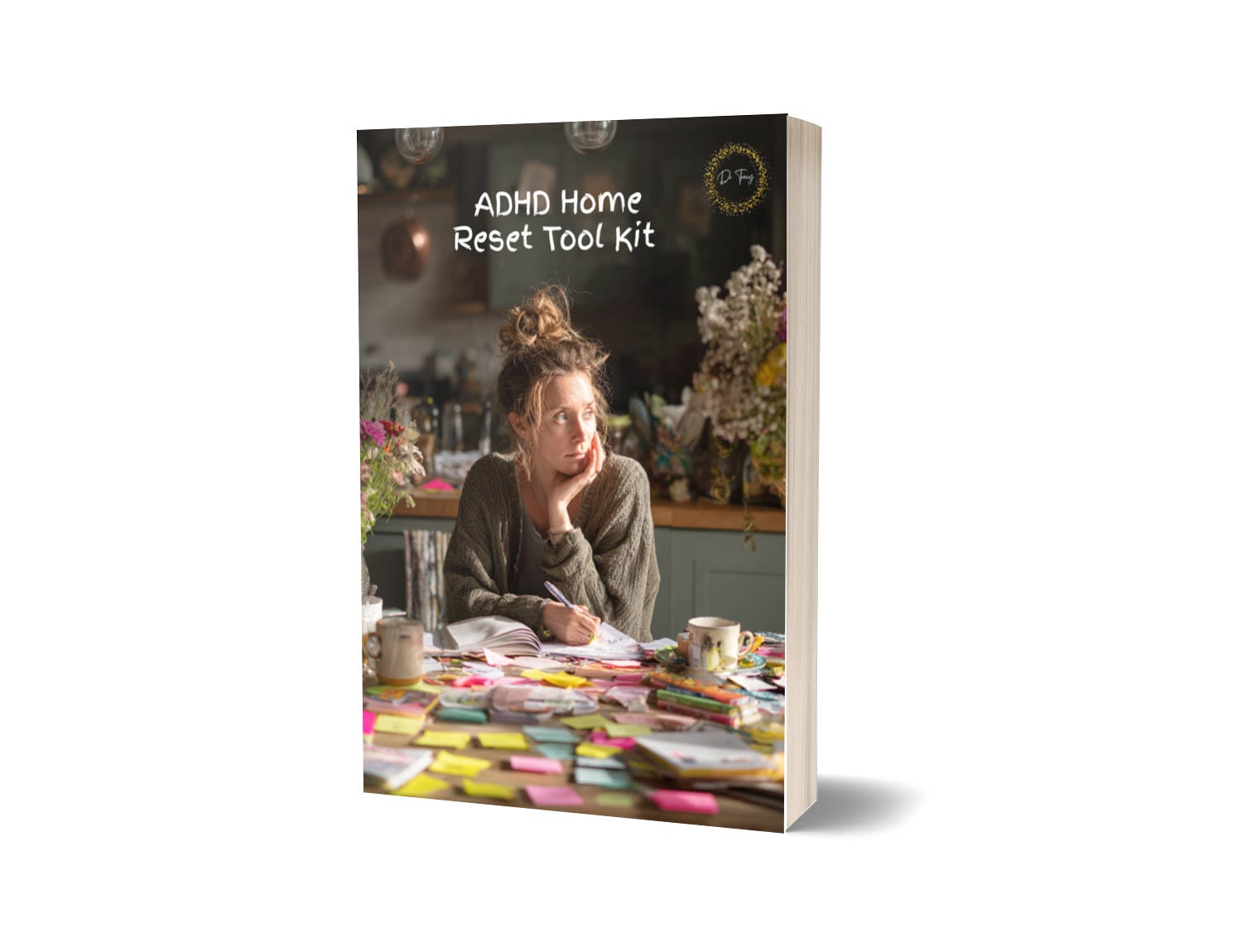
Paid subscribers can scroll down to my ADHD Home Reset Toolkit, a guide with five more tailored rituals, to help your evenings start softer and end clearer. Subscribe to access and give your brain the re-entry it deserves.
Click the image below to get my free ebook with some tips on coping with Rejection Sensitive Dysphoria

I was privileged to talk on the HerStory Podcast recently - have a listen below.

So What Shift Are You On Today?
If this article resonates and you’re working multiple shifts in a day, most of them invisible, you’re living with a brain that requires conscious, compassionate strategy.
And you don’t have to do it alone.
My coaching programme is designed for women with ADHD who look like they’re managing, but feel like they’re drowning. If you’re ready to work with your brain, your energy, and your actual life, click below to find out more.
You deserve support that sees you.
Click the image below to find out more.

I have also just launched a mini course on Rejection Sensitive Dysphoria with ADHD. Click the image below to explore more.

If you don’t want a regular commitment but would like to contribute to me helping others then click below to buy me a coffee!
I recently spoke about the importance of learning to work with your nervous system, which includes grounding, on UK Health Radio - click the image below to listen.

If you feel you want to try some meditations to help you reconnect with your body which can really help when trying to set boundaries, as you can learn to feel when something does and does not serve you. Click the images below to find out about the specific focus of each. All my meditations use healing frequencies, subliminal messages and binaural beats to enhance recovery - if these terms feel meaningless click, the images to find out more.


For media enquiries please see my press page